


Life raft: bag or container?

→ Liferaft: which packaging to choose?
The question of packaging is essential in the to install on your boat. How do you choose between a bag or a container ? What are the advantages and disadvantages of one or the other? We take a look at the most important concepts.
The packaging of a comes in 2 forms: in a bag or in a container.
Containerized packaging offers greater protection and security for the raft, which is more resistant to bad weather and handling (especially duringwinter storage). A containerized liferaft also offers easier launching and launching. It is the ideal storage method for installation outside the boat.
Bag packaging is very practical and, because of its compactness, is particularly suited to small boats. Although this is the lightest form of packaging, it is nevertheless very fragile. It must therefore be handled with care. This type of storage is preferable if you wish to install your liferaft in a trunk or inside the boat.
→ Liferaft, last resort in case of shipwreck
A liferaft is mandatory when sailing more than 6 MN, i. e. in semi-high seas. A liferaft takes the form of an inflatable dinghy that you deploy as you prepare to abandon ship.
The has established itself as a key player in the field. With its Cruiser, Coastal and Transocean models, the Lorient, France-based company has become a benchmark in the field.
You'll need a liferaft with a number of places corresponding to the number of people aboard your boat. For example, if you're taking a crew of 5 on board, you'll need to invest in a (you + 5 crew members = 6 people on board).
-
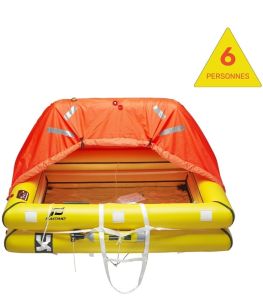
![]() PlastimoTransocean raft ISO 9650-1 Plastimo -€1,427.85 -5% was €1,503.00
PlastimoTransocean raft ISO 9650-1 Plastimo -€1,427.85 -5% was €1,503.00€1,503.00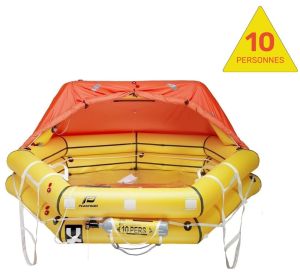
![]() PlastimoTransocean raft ISO 9650-1 Plastimo -€1,809.75 -5% was €1,905.00
PlastimoTransocean raft ISO 9650-1 Plastimo -€1,809.75 -5% was €1,905.00€1,905.00
![]() PlastimoTransocean raft ISO 9650-1 Plastimo -€1,326.20 -5% was €1,396.00
PlastimoTransocean raft ISO 9650-1 Plastimo -€1,326.20 -5% was €1,396.00€1,396.00→ Where to install my life raft on board?
Your can be packed in a bag or container before being installed on board. We recommend that you use a suitable support and fit it to the transom or stern pulpit. The deck of your boat can also be a solution, but bear in mind that the distance between the water and your liferaft should be as short as possible. The closer your liferaft is to the sea, the easier it will be to activate in an emergency.
In either case, make sure you position your liferaft the right way round. Arrows show you how to position it correctly. For a container liferaft, check that the release system is pointing upwards.
Whether in a bag or a container, we recommend that you never walk on your liferaft. Even if a container liferaft seems to us to be the best alternative, it's up to you to choose between a bag and a container, depending on your type of boat and your preferences.

Life raft: lifespan and overhaul
The is mandatory and must be carried out every 3 years, for all models. This overhaul of your liferaft enables you to check all the equipment on board, the structural integrity of the liferaft and to replace any out-of-date equipment. Current regulations therefore require a compulsory liferaft overhaul every 3 years, but overhaul methods may vary from one manufacturer to another.
Some manufacturers work with specialized overhaul stations located all along the French coast, and approved by the majority of manufacturers. Other manufacturers, such as Plastimo, only overhaul their liferafts at the production site in Lorient.
Since the introduction of the new standards, liferafts are overhauled every 3 years, and the gas cylinder used to inflate the liferaft is changed every 9 years (at the third overhaul).
→ How do you deploy your life raft?
If your ship is sinking, you'll need to deploy your liferaft to take refuge in until help arrives.
As mentioned above, you'll need to place it on the deck of your boat, ready for use. Your liferaft will be connected to your boat by a mooring line protruding from the container (closed during navigation).
Take the liferaft out of its packaging, and throw it into the water as is. The automatic inflation system will be triggered by the strap and will take care of giving it shape.
Then all you have to do is climb aboard the ladder and protect yourself from the wind, cold and spray with the raft's tent.
→ Bag or container: advantage or disadvantage?
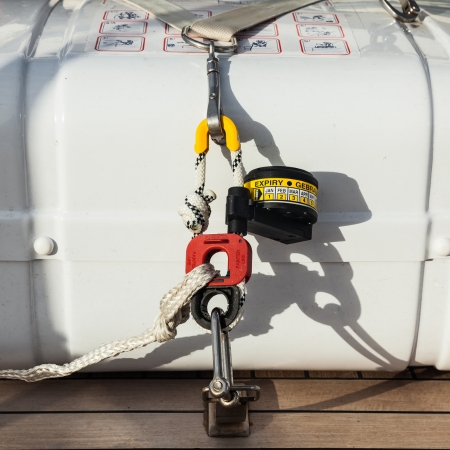
White in color, the bag is made from highly UV-resistant coated canvas, which allows some flexibility in storage volume, but it will need to be placed in a protected area, without stepping or sitting on it.
Heavier and more expensive, the container provides better protection, and its handles make it easier to grip when launching. Combined with a cradle or a suitable support, they make it easy to get aboard, even in the skirt or flat on deck.
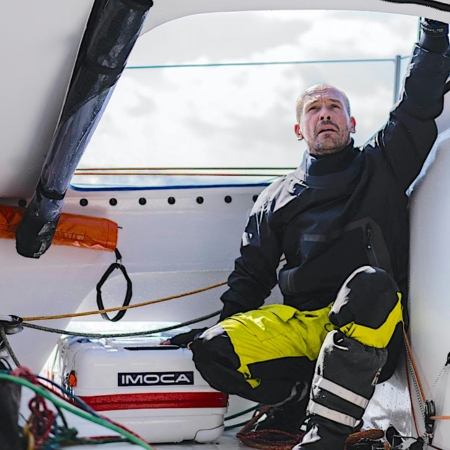
Please note that the 24 h and + 24 h liferaft models are not different in their construction, but in their water and food rations, which increase in proportion to the length of time the survivors have to wait.
-
![]() PlastimoTransocean raft ISO 9650-1 Plastimo -€1,427.85 -5% was €1,503.00
PlastimoTransocean raft ISO 9650-1 Plastimo -€1,427.85 -5% was €1,503.00€1,503.00![]() PlastimoTransocean raft ISO 9650-1 Plastimo -€1,809.75 -5% was €1,905.00
PlastimoTransocean raft ISO 9650-1 Plastimo -€1,809.75 -5% was €1,905.00€1,905.00![]() PlastimoTransocean raft ISO 9650-1 Plastimo -€1,326.20 -5% was €1,396.00
PlastimoTransocean raft ISO 9650-1 Plastimo -€1,326.20 -5% was €1,396.00€1,396.00→ Ensure your safety with our life rafts!
Whether you're sailing inshore or offshore, the choice of your must meet your specific needs and current safety standards.
At Nautisports, we've selected reliable, high-performance liferaft models from benchmark brands like Plastimo and 4Water. From compact rafts for short-term survival to models equipped for long crossings, each option is designed to guarantee your safety at sea.
Note that a canister or containing a first-aid kit, waterproof flashlight, insulating blankets, 1.5 liters of water and 500 g of food ration per person will enhance survival.
Don't hesitate to consult the product sheets to compare certifications, packaging, equipment and capacities. Your safety deserves the best, so choose the right, certified equipment.


