


How to moor a boat properly

→ Mooring a boat, what you need to know
Mooring a boat involves positioning a craft alongside a quay or pontoon and holding it in place with a dedicated called a
To moor a boat properly, you need to use the right equipment and apply your knowledge of mooring techniques.Mooring a boat is a crucial step when you're returning from your daily outing, or when you want to anchor for a stopover.
A is normally attached to the mooring bollards present on the quay, or to the mooring rings provided for this purpose. Mooring a boat is in fact a way of parking your craft, just as you would park your car in a parking space.
This step is all the more important as it's what keeps your boat secure and stable at the dock. To ensure the safety of your sailboat, catamaran... you need to be aware of the techniques and equipment required for a proper boat mooring.
→ Fender, essential for mooring a boat
The fender, which falls into the category of , is the main element that will protect your boat's hull from movements and waves pushing it against the edge of the pontoon, or against your dock neighbor's boat. For example, on an 8-meter boat, inflatable fenders should be positioned towards the center of the boat, every 2.5 meters along the hull.
We recommend a minimum of 3 fenders on each side. And for optimum efficiency, your fenders should measure at least 2/3 of the height of the freeboard, i. e. the vertical distance between the waterline and the dock.
Finally, to ensure that your fenders are operating at peak efficiency, we recommend checking their pressure once or twice a year. To do this, you can use a pressure gauge or measure the circumference of your and see if it has decreased.
Below are our recommendations for the pressure of your boat fenders:
▪️ Standard fender: 0.15 to 0.2 bar
▪️ Spherical fender: 0.15 to 0.2 bar
▪️ Bumper: 0.07 to 0.10 bar
Finally, depending on the mooring position you opt for, you may wish to install a to avoid any sudden shocks when mooring. Especially if your neighbor is mooring alongside your boat, the latter will be protected to the maximum.
☑️ Take the time to consult our buyer's guide for the most suitable for your boat.


→ Which rope to use to moor a boat?
What kind of rope is used to secure a boat to a dock or anchorage? As we mentioned in the introduction, there are different types of rope, each with a spliced eye formooring a boat. For example, the belongs to the category of ropes used to securely moor a boat.
There are also leaded mooring lines, such as the leadedor the hump, and other products such as mooring humps to stabilize your boat at dockside. In addition, a useful accessory for your boat can accompany your mooring line, such as a .
→ How to choose your mooring line shock absorber to be on the safe side?
There are different types of mooring rope shock absorbers. They can be galvanized, rubber, stainless steel or silent. Also known as , this accessory ensures the absorption of shocks and movements exerted by the water when moored.
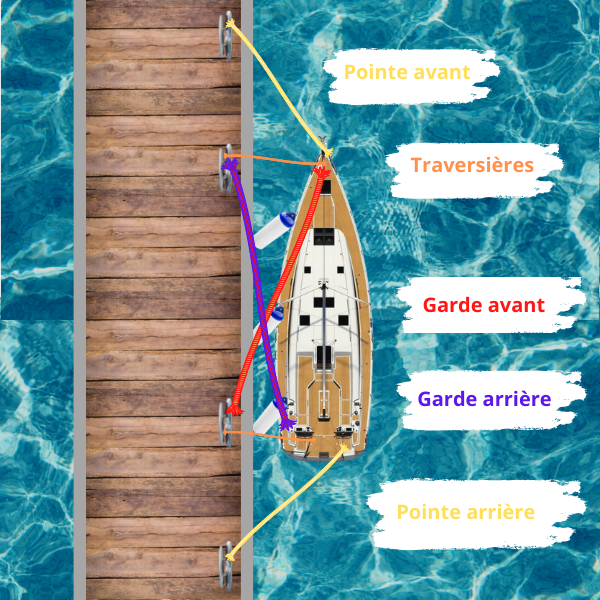
Every good sailor needs to know about the three types of mooring lines essential for stabilizing a boat at anchor. Firstly, the points, stretched outwards, provide the main anchorage for your boat. Next come the guards, which cross between the bow and stern of the boat, maintaining longitudinal balance. Finally, the crossbeams, perpendicular to the boat, although not essential, reinforce the boat's lateral stability, especially in swell or windy conditions.

The 5 best ways to moor a boat
The five best positions for mooring a boat alongside a quay that every boater should know include: alongside the quay, or alongside, stern to quay, alongside another boat, on a perpendicular catway or on a floating box connected to a deadweight.
Each of these mooring methods is adapted to harbor conditions, the size of your boat (sailboat or motorboat) and the configuration of the infrastructure.
→ Mooring alongside the quay
With a mooring alongside the quay, the boat is positioned the boat parallel to the quay, held in place by mooring lines at the bow and stern.
This configuration offers easy access on board and is ideal for short stopovers or simple maneuvers.

→ Mooring a stern-to-shore boat
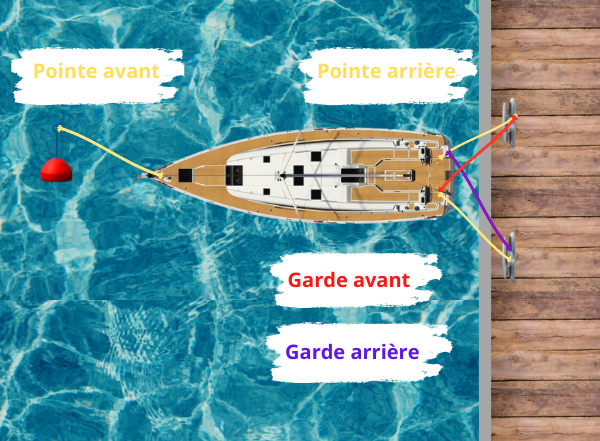
The boat is moored perpendicular to the quay, with the stern alongside. The bow is held in place by an anchor, halyard or trunk.
This method is common in Mediterranean ports, and optimizes the space available along the quay.

→ Pair mooring with another boat
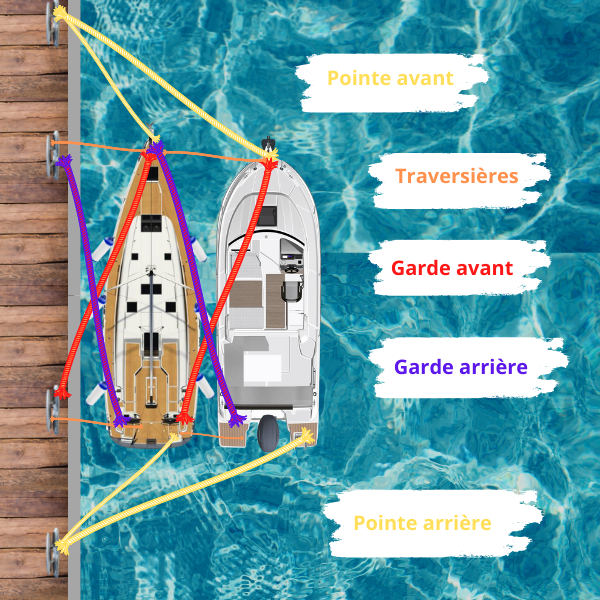
The boat is moored in parallel with another boat already moored, by attaching its mooring lines to the of the neighboring boat.
It is essential to askpermission from the owner of the boat already moored, and to ensure that the fenders are correctly positioned to prevent damage.

→ Mooring a boat on a catway
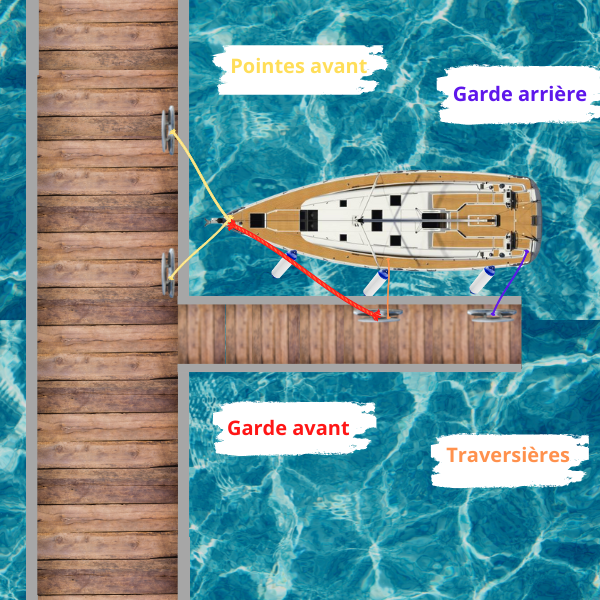
The boat is moored along a catway, a floating gangway perpendicular to the main pontoon.
This requires the use of spikes, guards and sometimes crossbeams to ensure optimum stability, especially in windy or cross-current conditions.

→ Taking a mooring locker
The boat is moored to a buoy, or trunk, connected to the bottom of the water by a chain and dead weight. We stop the boat facing the wind/current component in the immediate vicinity of the box to tie up.
The trunk is specifically designed for mooring a boat. This maneuver is often used in areas with no port infrastructure, offering a secure mooring solution at sea.


→ Which knot for mooring a boat?
Which knot for mooring a boat is a must? Tying techniques are essential for safely mooring a boat alongside the quayside. Good mooring requires not only the right rope, but also the right knots. That's why it's essential for every yachtsman, whether a beginner or an experienced sailor, to know and know how to tie the four main sailor's knots that are essential for mooring a boat.
Each knot responds to a specific situation: whether it's securing a mooring line to a cleat, or to an anchor bolt, the knot can be used for a variety of purposes , secure a fender with a , form a strong loop or make a fast, reliable boat mooring. A good knowledge of these knots not only saves time when maneuvering, but also avoids unpleasant surprises due to a poorly secured rope.
If you'd like to find out more, don't hesitate to visit our Practical Handbooks category, where you'll find our most frequently used !
→ Boat mooring knots to know
Below are the boat mooring knots to know:
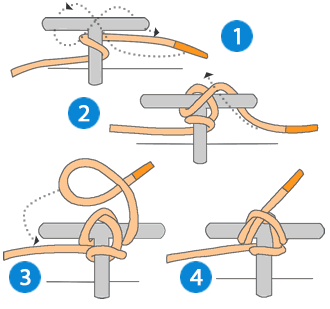
➡️ Cleat knot
As its name suggests, the cleat knot is used to secure your mooring line to a cleat. It consists of a dead turn, which is then accompanied by a figure-of-eight crossing, and ends with an inverted half-key. A dead turn is a turn around the element to which the rope is attached. This simple operation secures the boat. The cleat-tying knot is the most popular way to tie up a boat.
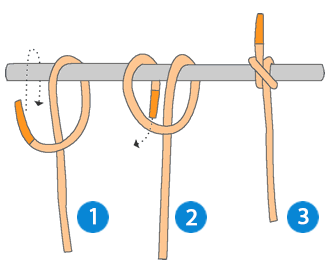
➡️Capstan knot
This mooring knot, known as the capstan knot, is the knot for tying up like a ballyard or for securing to a mooring bitt. Easy to tie, this requires maximum tension, as its main drawback is a tendency to slip. Use a half-key at the end of the tightening process to secure it.
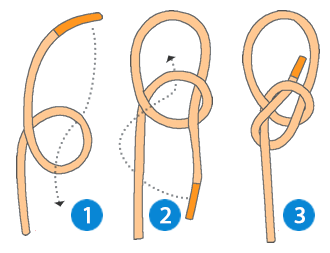
➡️Chair knot
This is the most common knot you may have to tie on your boat mooring line. All you need to do is make a firm, solid loop.
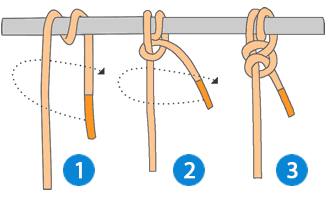
➡️Dead turn and two half keys
Because a dead turn and two half keys will never let you down, this knot is the easiest to remember and tie if you're heading out to sea without much knowledge. In fact, it's very easy to tie and release, despite the tension that will be exerted on it. Two classic knots follow the dead turn, known as two half-keys. For use on board your boat, on the pontoon and for attaching fenders.

Bien amarrer un bateau à quai ?
Bien amarrer un bateau passe par l'utilisation d'équipements adaptés et l'application de ses connaissances sur les techniques d’amarrage. L'amarrage d'un bateau est l’étape cruciale lorsque vous rentrez de votre balade journalière ou que vous faites une halte lors de celle-ci. Amarrer un bateau consiste à le fixer contre un quai ou un ponton, grâce à un spécialisé appelé . Ces amarres s'attachent en principe sur les bittes d'amarrages présentes sur le quai, ou sur des anneaux prévus à cet effet. Amarrer est en fait une façon de garer son bateau.
Elle est d’autant plus importante que c’est celle qui va permettre de garder votre bateau en sécurité et stable à quai. Pour assurer ainsi la sécurité de votre voilier, catamaran etc…vous devez prendre connaissance des techniques et équipements impératifs pour réaliser un amarrage de qualité !
Le pare-battage, un élément indispensable pour amarrer
Le pare-battage, autrement appelé « bourrelet de défense », est l’élément principal qui va protéger la coque de votre bateau des mouvements et des vagues le poussant sur la bordure du ponton, ou sur le bateau de votre voisin de quai. A titre d’exemple, sur un bateau de 8 mètres, ces équipements gonflables sont à positionner vers le centre du bateau, tous les 2.5 mètres. Quoi qu’il arrive, votre bateau doit détenir au minimum 6 pare battages. Pour une efficacité optimale, ces objets gonflés doivent impérativement mesurer en hauteur 2/3 de la hauteur du franc bord, autrement dit la distance verticale entre la ligne de flottaison et le quai.
Les meilleurs pare-battage du moment :
Enfin, pour que votre matériel de protection soit au maximum de sa capacité, il est recommandé de vérifier la pression 1 à 2 fois par an. Pour effectuer ce contrôle, vous pouvez utiliser un manomètre ou bien mesurer la circonférence du produit comme pour le cas du
. Voici donc les préconisations pour la pression de votre équipement : Conseil : selon la position d’amarrage pour laquelle vous optez, il est possible d’installer une
pour éviter des chocs trop brutaux lors de l’amarrage. D’autant plus si votre voisin amarre à couple de votre bateau, ce dernier sera protégé au maximum Ensuite, il existe différents modèles de cordage qui, notamment, disposent d’un œil épissé permettant d’amarrer votre embarcation. A titre d’exemple, le
fait partie de la catégorie des cordes permettant d’amarrer un bateau. On retrouve également des amarres plombées telle que l’ ou la . D’autres produits telles que les bosses d’amarrage et de mouillage permettent de stabiliser votre bateau à quai. D’autre part, un accessoire utile et intéressant pour votre bateau peut venir accompagner votre amarre. Il s’agit des ressorts.
Les meilleures cordes d'amarrage du moment :
Il existe différents type de ressorts. Les ressorts galvanisés, les ressorts en caoutchouc, ceux en acier inoxydable, et, les silencieux. Aussi appelés « Amortisseurs », ces équipements bateaux assurent l’absorption des chocs, comme leur nom l’indique. Voici donc en illustration ces 4 types d’amortisseurs bateaux. D'abord, tous les marins doivent savoir distinguer les 3 types d’amarres qui stabilisent un bateau lors du mouillage. On retrouve donc en premier les pointes, qui sont des cordages positionnées en direction de l’extérieur. Viennent ensuite les gardes, qui se croisent de l’avant vers l’arrière et inversement. Enfin, le troisième type d’amarre est appelé les traversiers. Ceux-ci sont perpendiculaires au bateau. Ils ne sont pas obligatoires pour le mouillage de votre bateau. Cependant ces cordages viennent renforcer la stabilité de votre navire sur l’eau. Il s’agit d’un amarrage au sein duquel votre voilier ou autre est parallèle au quai grâce à 4 amarres. Celles-ci sont positionnées comme sur l’image suivante : Comme son nom l’indique, le marin se gare dans le port avec la partie arrière de son bateau perpendiculaire au quai. Dans cette position, à l’avant le véhicule flottant est maintenu par un coffre*, une ancre ou une pendille. Tandis qu’à l’arrière il est accroché à des bittes, des taquets à l’aide d’une aussière d’amarrage. De plus pour stabiliser au maximum celui-là, vous pouvez ajouter des amarres venant se croiser comme sur la photo suivante : *PS : Un coffre est une bouée flottante reliée à un poids mort immergé au fond de l’eau. Une pendille est un cordage ou une chaîne relié(e) à une chaîne mère fixée à un poids mort. Il s’agit tout simplement d’amarrer en attachant ses amarres sur les taquets d’un bateau collé au quai. Néanmoins, il ne faut pas négliger l’attache d’amarres sur le quai. Cela permet de démultiplier la pression exercée sur le voilier déjà stabilisé à quai. Un « catway » est une petite plateforme supplémentaire flottante, qui vient se située perpendiculairement par rapport au ponton ou quai principal. L’amarrage se réalise de la même manière que sur un quai, avec les 3 types d’aussières d’amarrage (Pointes, Gardes, Traversières) évoquées ci-dessus. Voici donc une illustration pour savoir comment amarrer un bateau sur un catway : Concernant ces cordages, les deux pointes avant permettent la stabilité de ce côté-là, et l’ajustement de la distance entre le bateau et le quai. Ensuite la garde arrière vient maintenir votre navire au plus proche du catway. Puis la garde avant vient immobiliser définitivement votre plaisancier. Enfin, l’utilisation de traversiers permet de faciliter l’embarquement et le débarquement en gardant votre bateau au plus près du catway. Placé en dernier dans ce guide, l’amarrage sur un coffre est une solution rare et utilisée le plus souvent par de grands navires. Pour réaliser cette opération, un petit bateau est utile pour guider le navire lors de la phase d’amarrage. Ce petit modèle transporte donc les aussières jusqu’au coffre d’amarrage. Lorsque vous amarrer ainsi, la vitesse et le sens de déplacement de votre bateau doivent être identiques à ceux du navire afin d’éviter la bascule du petit bateau à cause d’aussières trop tendues. Néanmoins, si vous possédez un voilier ou même un petit gabarit de bateau, vous pouvez également tenter un amarrage sur un coffre, c’est-à-dire une bouée stabilisée par un poids mort. Enfin, pour réaliser tout type d’amarrage, il est nécessaire d’avoir un bon matériel d’amarres et de savoir nouer des nœuds tenaces Ce sont ces techniques de serrage de corde qui permettent d’assurer le stationnement de votre bateau à quai. Il convient donc de connaitre les 4 principaux nœuds de cordage avant de prendre le large. Les voici : Comme indiqué dans son nom, le nœud de taquet permet de fixer votre amarre un taquet. Il s’agit d’un tour de mort, qui s’accompagne ensuite d’un croisement en huit, et enfin se termine par une demi-clé inversée. Un tour mort est un tour autour de l’élément auquel est accroché le cordage. Avec cette simple manipulation le bateau est bloqué. Le nœud d'amarrage sur taquet est le plus populaire pour amarrer un bateau. Récapitulatif : Ce nœud d'amarrage appelé nœud de cabestan est idéal pour accrocher un pare-battage ou pour amarrer sur une bitte. Ce nœud nécessite une tension maximale, puisque son défaut est qu’il a tendance à glisser. Privilégiez donc une demi-clé en fin de serrage pour fixer le tout. Récapitulatif : Ce nœud est typiquement celui que vous pourriez être amené à réaliser sur votre amarre. Il s’agit tout simplement de réaliser une boucle solide et ferme. Récapitulatif : Parce qu’un tour mort et deux demi-clés ne vous laisseront jamais tomber si vous partez en mer sans grandes connaissances, ce nœud est le plus simple à retenir et à réaliser. En effet, il se construit et se largue très facilement, et ce malgré la tension qui sera exercée sur lui. Deux nœuds classiques suivent le tour mort, c’est ce que l’on appelle deux demi-clés. A utiliser sur votre bateau, ponton, et pour attacher vos pare-battages. Récapitulatif : L’équipe Nautisports
Quel cordage d’amarrage choisir pour bien amarrer un bateau au mouillage ?
Comment choisir ses ressorts d'amarrage pour être en sécurité ?
Les 5 meilleures positions pour amarrer un bateau au ponton
« Alongside » ou le long du quai
Poupe à quai
Amarrer à couple d’un autre bateau
Sur un « catway »
Sur un coffre

Quels nœuds d’amarrage pour amarrer un bateau ?
Nœud de taquet
Nœud de cabestan
Nœud de chaise
Le tour mort et deux demi-clés
Retrouvez d'autres articles dans la même thématique ici :
- Les
pour votre bateau
- Bien
les drisses de votre bateau



